


The New Normal

The new normal, isn’t it a new black?
Be it work from home for working professionals or mask and sanitizers in our checklist or say queuing being the new norm. Salary cuts and Job losses have all become the new status quo. For many people right now, coronavirus pandemic reminds of 9/11 or the 2008 financial crisis that reshaped the society in enduring ways, for how we travel and buy homes, to the extent of protection and surveillance we’re accustomed to, or even to the language we use. Correspondingly, voices can be heard from different corners about how we humans pushed the planet and nature to a state of revolt. The thought of ‘earth cleansing itself’ seems to be gaining some traction.
The virus has created its own hype because of which other diseases are being neglected. Due to this pandemic, the whole world is considerate about the virus and there has been a lot of talk about the direct deaths and other health implications due to the virus. But what hasn't been talked about is the toll that months of lockdown is having on the mental health of people. UN warned in march of a global mental health crisis due to the pandemic and a recent new study by GOQii found that close to 43% of Indians are suffering from mental illness. All of this was before the widespread job losses and the worst economic recession since the Great Depression.
Healthcare sector has taken a centre stage. We know that the healthcare sector is ill-equipped to sustain pandemics and epidemics. National Health Profile 2019, shows that India spends only 1.29% of its GDP (2017-2018) as public expenditure on its healthcare which means that India‘s Public investment is lower than that of low-income countries like Bhutan, Sri Lanka and Nepal. The sluggish expenditure on public health in India reflects the lack of political support for health and the inability of policymakers to understand that poor health holds back the development of the country. This has led to increased spending by people at private health facilities with out-of-pocket expenditure. Out-of-pocket expenditure is so high in the country that it exceeds the world average. According to WHO, in 2017 67.78% of the amount was paid out-of-pocket whereas the world average was just 18.2%. This small difference pushes up to 63 million people in India into poverty each year. This number is set to skyrocket post-pandemic.

As part of the Sustainable Development Goals, all countries committed to leaving no one behind and pledged to deliver Universal Health Coverage by 2030. Universal Health Coverage goal is to ensure that all people obtain healthcare services that they need without facing any financial hardship. It includes health protection, promotion, prevention, treatment, rehabilitation and palliation. This includes India. The country has failed to invest in healthcare and has barely scratched the surface. This means that there is inequality between the rich and the poor that possibly leads to rich and middle-class people surviving the crises but what about the millions below the poverty line? The need of the hour is to ensure that public health experts and technologist create solutions so that electronic health records can be maintained to support better health decisions.
According to the Human Development Index 2019, India is ranked at 129th out of 189 countries which put the country in the medium human development category. Countries having a higher life expectancy or say having much better infrastructural facilities to deal with the epidemic diseases are also badly affected due to this pandemic. Epidemic Pandemic aren’t you confused? Let's take an example of Italy which is ranked at 29th in case of HDI, was oddly one of the worst affected. Italy even with its more superior healthcare infrastructure had a death rate that was 5 times more than India, this suggests that while a well-developed healthcare sector helps, it isn't enough to successfully save lives. This means that even though the countries are prepared for epidemic diseases there is a need for ‘Pandemic Preparedness.’

A Looming question that arises now is what’s next?
The first and obvious step is to increase the Government spending on Public health so that existing facilities can be improved and new facilities can be added. At least 2.5 % of GDP should be invested in the healthcare sector. The private sector is the substratum of our health infrastructure and must be supported. If the Government can’t do so directly, a policy framework should be developed to encourage private players to do so. It depends upon the Government on how actions need to be taken to tackle the pandemic emergency. Recalling on this, you must also know that Government of India transformed its unused railway compartments to COVID beds that can be used at times of emergency. This shows effective use of mobilization of resources as well as to what extent a country is self-reliant in terms of essential commodities and health infrastructure so that there is less disruption due to crises.
A major role is to be played by Insurance Companies. Insurance companies should give some amount of rebate to their customers which will eventually be a win-win situation for both the company and the customer as Customers out of the pocket expenditure will decrease whereas insurance companies will get more insurers due to this scheme. Be it a Public healthcare Sector or a Private healthcare sector, what India needs is the Quality healthcare sector.
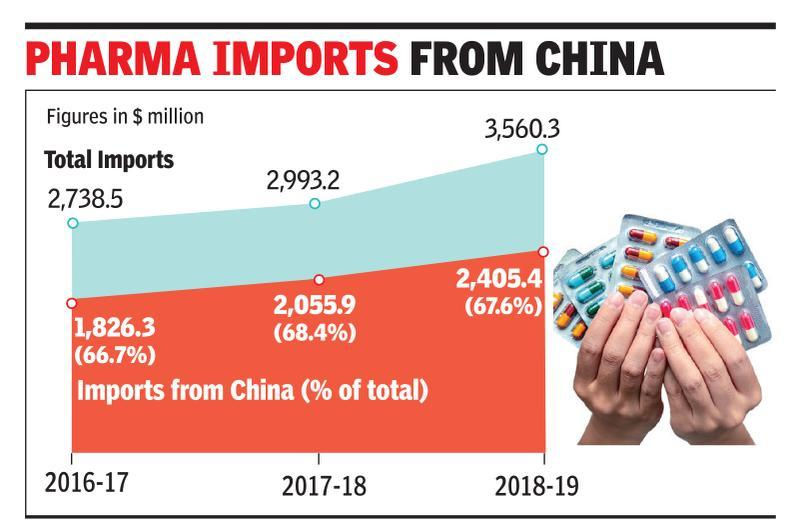
Also, India is an import driven country for medical devices. According to data compiled by Association of Indian Medical Device Industry, the country’s import for the year 2019 was 24% more than that of the previous year. China is one of the biggest suppliers of API to India. The country imports 70% of its APIs (Active Pharmaceutical Ingredients) which are the key parts of a drug which produce an effect. APIs are crucial chemical compounds that are required to manufacture medicines. The crisis has made the country realize about the over-reliance on China. What do you think about the Atmanirbhar move made by India? Will the country be self-sufficient in catering the API demand and fully substituting the imports?
The Answer to this is YES. It is an incredible opportunity for the Pharmaceutical sector to revitalize domestic API business. Deteriorating relations is also one of the reasons to find alternatives quickly as medication availability is a matter of national interest. This cannot be done overnight. This needs sustained support from the Government.
Investing in healthcare is not a luxury. It is a need – BASIC NEED.
That time is also not far when carrying Immunity passport will be as important as having a visa while travelling abroad.
As UNICEF has put it: “The stakes could not be higher. If not adequately or appropriately addressed, the mental health consequences for a generation of children and young people could far surpass the immediate health and economic impact of the COVID-19 pandemic, leaving long-term social and economic consequences in its wake.”
Pondering upon this, things will come back to track in the long run, but the definition of normal will be changed.
Life will not be the same. It’s time to restart.
Welcome to the new normal.


Comments